

Open
Space Technology is a simple meeting methodology involving
from 7-1000 people, that produces results, achieves maximum participation
and "buy-in" during the meeting and later implementation,
unleashes unlimited creativity, and inspires your team in finding
the best solutions to their challenges.
"Open Space Technology" is the name given to
a meeting without a predetermined agenda. Developed in the late
eighties by Harrison Owen of Maryland, U.S.A., this meeting methodology
is now used around the world as an effective process for facilitating
change in both organizational and community settings.
Facilitating
an Open Space Technology meeting is easy. However, even a single
Open Space Technology meeting for the longer term benefit of the
organization requires more than the facilitation of a well-done
meeting. It requires care with the right theme or focusing question,
care with accurate "givens" or non-negotiable items
that clearly identify what space is open and what is not, and
care to ensure that the leadership in the organization receives
guidance in how to make the best use of the results coming from
the meeting.
Although discussions
themselves are not subject to boundaries, we work with clearly
defined boundaries for what the participants can expect as the
result from having participated in an Open Space Technology meeting.
Open Space
Technology meetings are simple to organize, require very little
lead time, are effective for any sized group from seven to one
thousand, are effective for established groups such as corporations,
private sector and public sector organizations, government and
non-government organizations, coalitions, teams or communities.
They enable the building of energy and participation in ways that
few other processes do. Open Space Technology meetings create
the conditions for interactive processes that allow leadership
to surface naturally.
Open Space
Technology is best used when there is an important issue to be
addressed; there is a diversity of people involved; there is complexity;
and when decisions need to be made quickly.
Open Space Technology operates on four Principles and one Law
The
four Principles are:
1. Whoever
comes are the right people. This reinforces that the wisdom to
achieve solutions is present in the room and the group is not
to worry about who is not present nor to panic about who is.
2. Whatever
happens is the only thing that could have. This keeps the attention
on the best possible effort in the present, not worrying about
"what we should have done".
3. Whenever
it starts is the right time. This reminds people that creativity
cannot be controlled.
4. When its
over, its over. This encourages people to continue their discussion
so long as there is energy for it. Some sessions will finish well
within the anticipated time. Others will run longer than the time
allotted.
The
one Law or rule is called The Law of Mobility
Also known
as The Law of Two Feet, this indicates that people can enter or
leave an open space session as they choose. If the session you
are in is not meeting your needs for either contributing or learning,
go to another one.
So how does it work?
An Open Space
meeting is announced. Duration is most commonly between one and
three days, though they can be shorter.
The venue
is a large conference room with lots of "break-out"
or session rooms or areas adjacent. When people arrive for the
Open Space Technology meeting, they initially come to the plenary
room and find a venue in which there is an empty room, except
for a large circle of chairs. The circle is an invitation to communication
with no barriers.
The workshop
begins with a welcome by the sponsor that is brief, highlighting
the theme and the "givens" and then a facilitator who
explains how the Open Space Technology workshop will operate.
The broad purpose of the workshop is stated again, as are the
"givens" or constraints. An example of a broader theme
might be "Issues and Opportunities for the Future of the
Organization". Sometimes the broad purpose is quite focused
such as "Issues and Opportunities for reworking the assembly
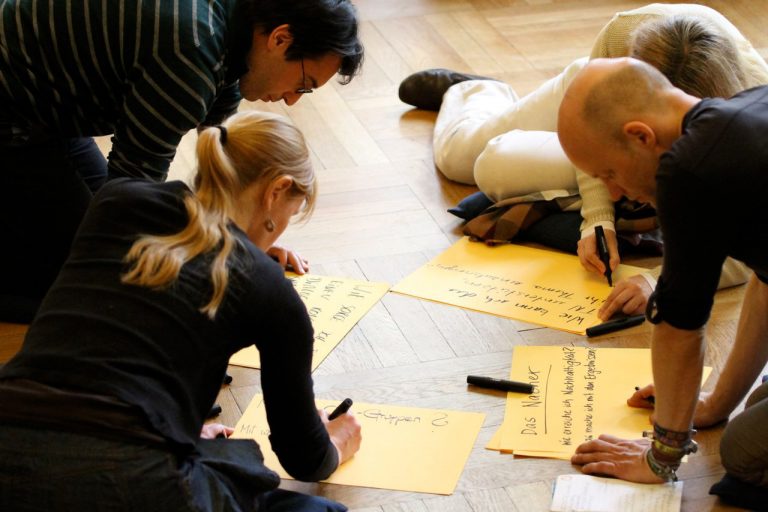
line". In the middle of the circle is a collection of newsprint
paper, masking tape, and felt pens. Participants are then invited
to create the agenda for the workshop. It works like this.
i. Anyone
who has any ideas at all that relate to this broad topic are invited
to take a sheet of newsprint and along the top write their topic
of interest or passion. People are asked for ideas for which they
have passion and for which they are prepared to take the responsibility
of leading a discussion group on that idea (they do not need to
have had previous experience in leading a discussion group but
simply to get their topic started and to be sure that everyone
who comes to their discussion has a chance to speak), and to make
sure a record of the discussion is recorded (report forms are
provided). The sheets announcing each of the ideas, along with
the name of the person who put up the idea and a note of when
the topic will be addressed and which breakout area it will be
in, are affixed to a blank wall. Participants can put up ideas
for which they have a lot of information including having handouts
that they have brought to the meeting for the purpose of sharing
the information, or they might know nothing more about the idea
than to have a question.
ii. The next
step involves a "market-place". All workshop participants
go to the market wall to look at the ideas outlined on each sheet.
When they find the topic of most interest to them, they sign up,
by writing their name on the sheet beneath the topic.
iii. The
next step involves participants going to the break out spaces
to participate in the topics of their choice. As far as possible,
each session is defined by a circle of chairs and no other furniture,
though it may have flip charts, post-its, felt pens, etc.The person
who posted the idea is responsible for leading the session in
whatever way s/he chooses. The facilitator has no involvement
whatsoever. The only requirement is that, at the end of the session,
the session leader brings back to a central point a summary of
session ideas, and who has agreed to do what. This is to be provided
in a somewhat standardized format, usually noted on a pro-forma
given to the session leader at the start of their session. It
is important to record the highlights of the discussion in such
a way that they can be understood by people who were not part
of the discussion.
iv. A bank
of computers is available and session leaders or a representative
from the group enters the report into a computer. As soon as a
report is entered, the facilitator prints a copy of it for a newswall
and posts it so that all participants of the broader meeting can
read about what has happened in each session. As well, a copy
of the report is made to be entered into a "book of proceedings",
a book that is comprised of all of the reports and contact information
of the participants so that they can reach each other for further
networking. This book is available to each participant of the
meeting. In a multi-day meeting, the "book of proceedings"
is handed to each person prior to a time of converging the various
topics and getting further input from the collective about next
step actions. In a meeting that is one day or less, the "book
of proceedings" is available to participant within the week,
either through a pick up or mailing. Often, the "book of
proceedings" is available electronically as well on a website
or by e-mail.
v. In meetings
where the intention is to move topics to action steps, the facilitator
conducts a summarising session for convergence, prioritizing and
action planning, including seeking input on next steps and follow-up.
This is a feature of Open Space Technology meetings that are longer
than one day.Open Space Technology has one outstanding characteristic
- the generation of energy and commitment. It also has one outstanding
enemy - control. It will not work where the energy and commitment
generated are not permitted to bear fruit. This is not to suggest
that OST is an invitation to anarchy. Far from it. Provided the
constraints -economic, political, legislative - are recognized
and spelt out very clearly at the start, and the areas where discretion
and freedom to be creative ("defining the space") are
also made clear, Open Space Technology is proving itself to be
a powerful tool for harnessing commitment and responsibility.
Several organization-wide Open Space Technology meetings within
a short time frame will start to shift an organizational culture
from something that might be de-energized into a more vibrant
organic networked community that is effectively producing results.
To complete
the shift in organizational culture and become a Conscious
Open Space Organization (COSO) requires time and attention.
Inspiration and support in sustaining the new paradigm developed
in work with Open Space Technology can be found in the many articles
and stories about the COSO written by Birgitt Williams and
others.
Bringing an Open Space Technology
Meeting to your Location
Open
Space Technology Training Workshops